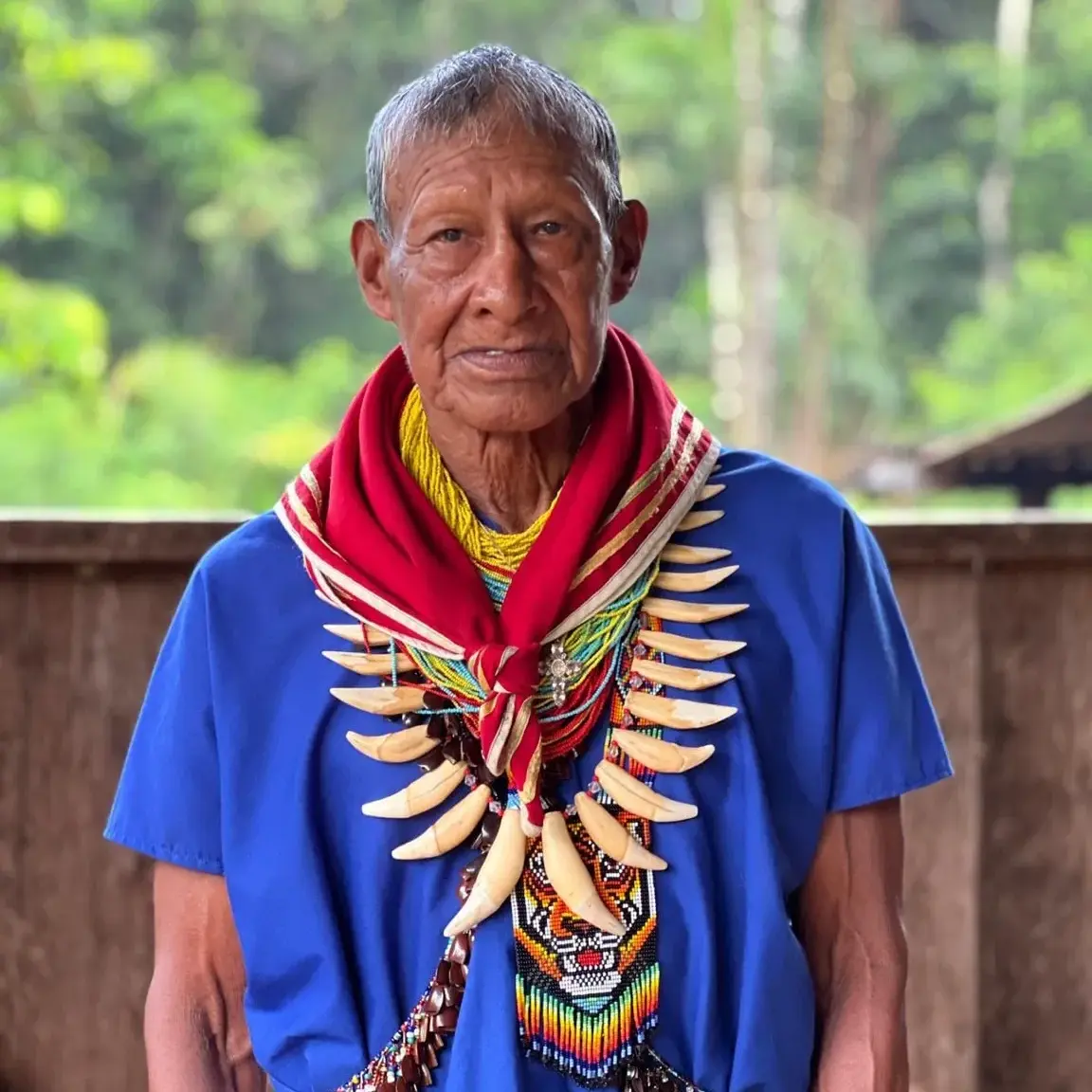
Iowaska is a common phonetic spelling of ayahuasca, the Amazonian plant medicine known in Colombia as yagé. This guide explains what the name means, how the experience is commonly described, how long its effects may last, and the safety questions to consider before joining a ceremony. Camino al Sol has worked within Colombia’s yagé tradition for more than 15 years.
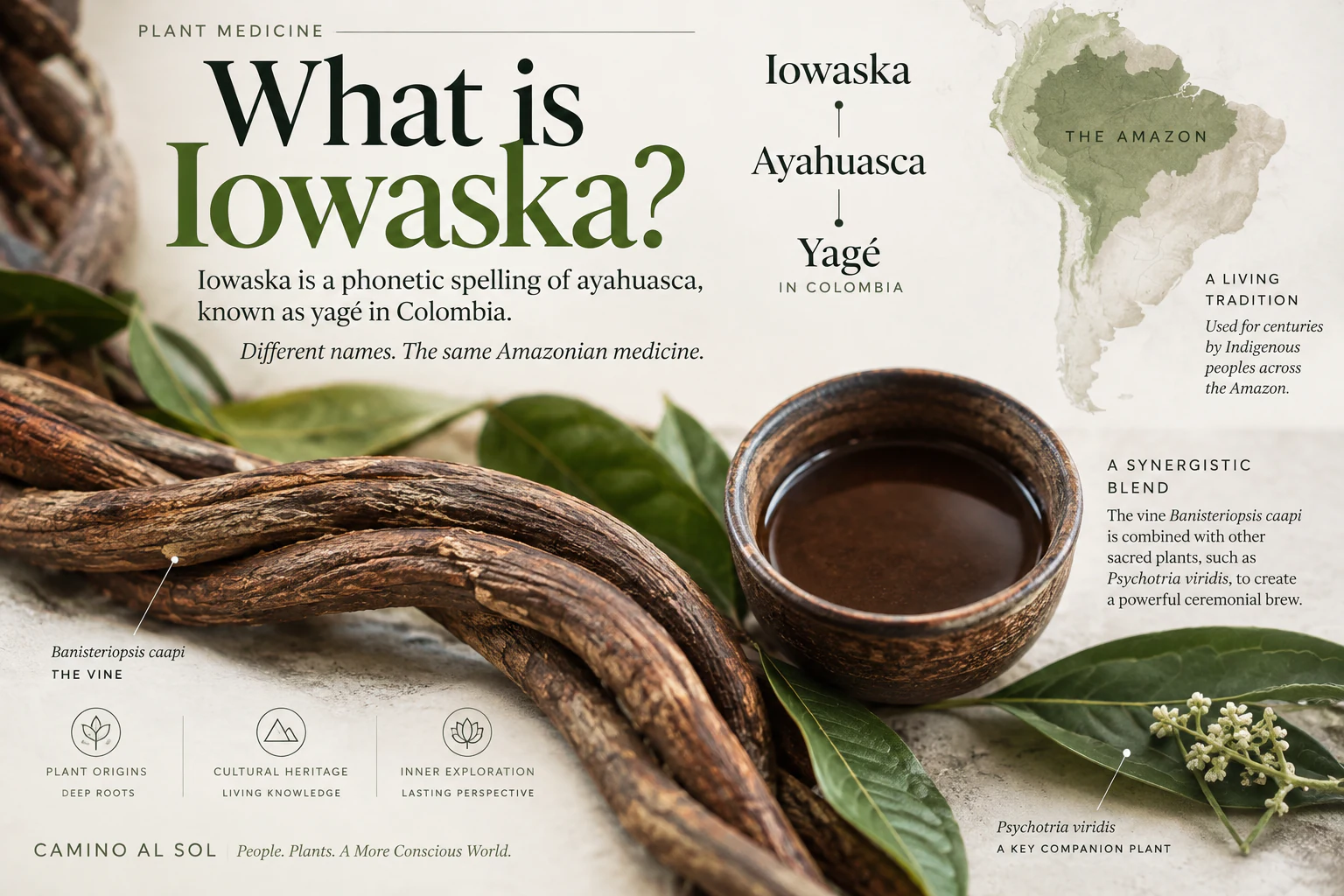
Iowaska, ayahuasca, and yagé are names readers may encounter across different languages and regional traditions.
What is iowaska?
Iowaska, ayahuasca, and yagé usually refer to the same traditional brew. The different words reflect pronunciation, language, and regional traditions rather than separate medicines.
- Iowaska: A phonetic English spelling of ayahuasca, based on how the word sounds.
- Ayahuasca: The name most widely used internationally and in parts of Peru and Ecuador.
- Yagé: The name commonly used in Colombia.
- Caapi: The Banisteriopsis caapi vine used in many traditional preparations.
- Daime and hoasca: Names used in particular Brazilian religious traditions.
Someone searching for “iowaska” is therefore usually looking for information about ayahuasca: what it is, what happens in a ceremony, what the risks are, and how to approach it responsibly.
Cultural roots: more than chemistry
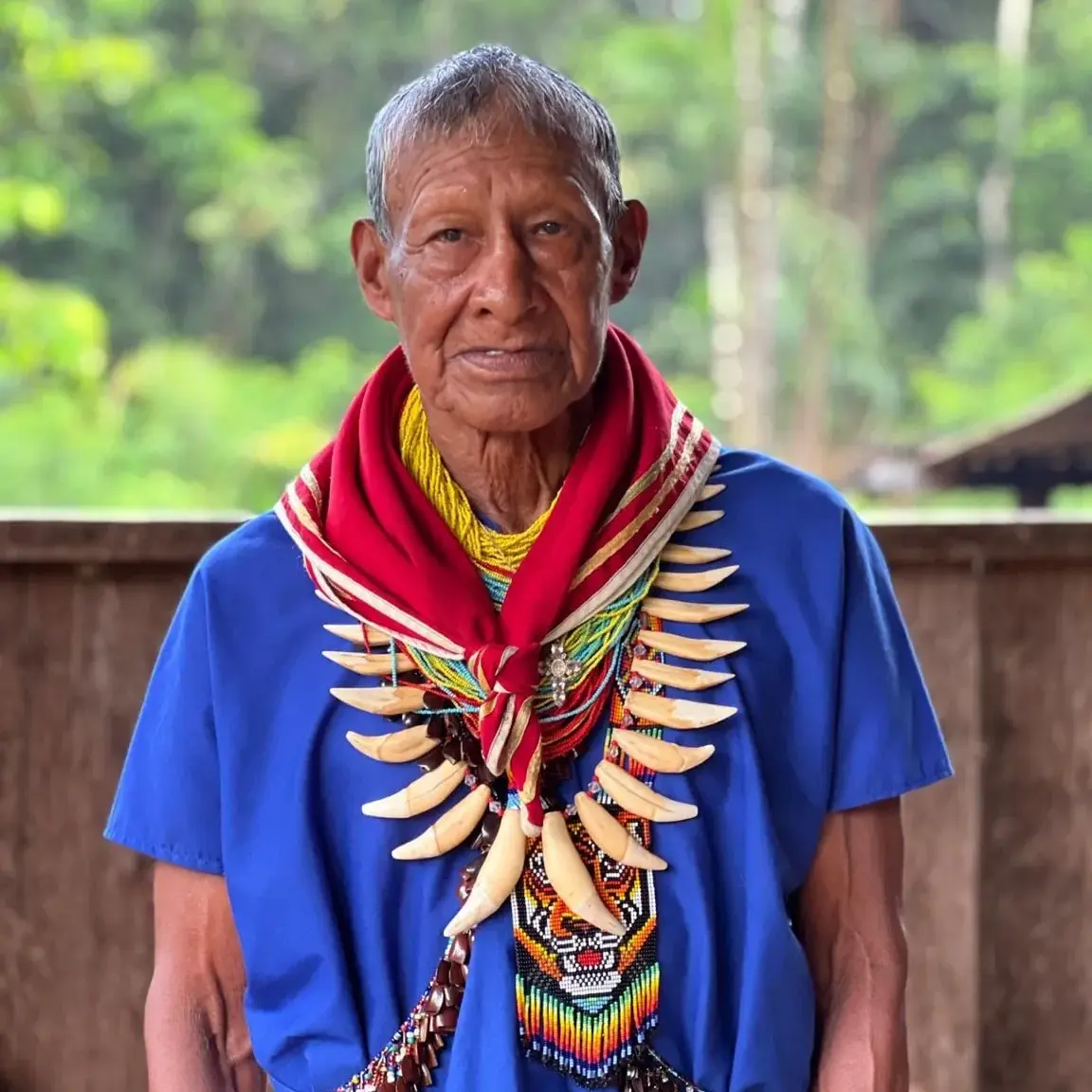
In Colombia, iowaska is understood less as a substance than as part of a ceremony held through lineage, preparation, music, prayer, and responsibility. At Camino al Sol, ceremonies are guided by experienced taitas and supported by facilitators who screen, prepare, and care for participants throughout the retreat.
At Camino al Sol, the medicine is normally called yagé. Diego Marmolejo, Camino al Sol’s médico tradicional, was born in Piñuña Negro near the Putumayo River in Puerto Asís, Putumayo. He describes his formation in traditional medicine as beginning within his family, including his mother, a sabedora with knowledge of traditional medicine and medicinal plants.
Diego says his knowledge of plants developed over roughly twenty years of collecting and learning, including time with Indigenous elders and visits to medicinal chagras in different communities. He also describes learning through walks with elders in the territory, identifying plants, discussing their traditional uses and, when appropriate, collecting plants so they can be reproduced.
Today, Diego describes his role at Camino al Sol as médico tradicional. His work includes caring for the territory and medicinal plants, traditional treatments, and helping preserve and document plant knowledge.
This provides a different perspective from approaching iowaska or ayahuasca as an isolated psychedelic substance. In the Putumayo context Diego describes, knowledge of yagé exists within a much wider relationship with medicinal plants, elders, territory and transmitted knowledge.
Traditional knowledge is not interchangeable with tourism or recreational use. The ceremonial container includes the people holding the space, the condition of the participant, the preparation before drinking, the music and prayer during the night, and the integration that follows. Chemistry can describe part of the brew, but it cannot explain the full cultural practice.
“I felt safe and held at all times; during the three ceremonies and the time in-between.”
— Carly Steadman
What is iowaska made from?
Many ayahuasca preparations combine the Banisteriopsis caapi vine with a plant containing DMT, often Psychotria viridis. The caapi vine contains beta-carboline alkaloids that affect how the body processes DMT. Recipes and plant names vary across communities, however, and it is misleading to reduce every traditional preparation to one fixed formula.
The brew should not be treated like a standardized consumer product. Strength, composition, individual sensitivity, health history, and ceremonial context can all affect the experience.
The plants used in traditional medicine also exist within a much wider body of botanical knowledge. Diego describes learning about medicinal plants through elders, medicinal gardens and time spent in different territories rather than through the study of one plant alone. At Camino al Sol, part of his work today involves cultivating and preserving medicinal plants and maintaining this knowledge over time.
What can an iowaska experience feel like?
There is no single predictable experience. Some people describe visual imagery, changes in time and perception, strong emotions, memories, spiritual reflection, or a sense of connection. Physical effects can include nausea, vomiting, sweating, shaking, changes in heart rate, and fatigue. Difficult fear, confusion, or psychological distress can also occur.
These effects are not proof of healing, and intensity is not the same as benefit. A responsible setting does not promise a cure or pressure participants to interpret every difficult moment as positive.
What Andrea notices with first-time participants
Andrea Díaz works closely with participants throughout retreats at Camino al Sol. She often notices uncertainty among people arriving for their first yagé ceremony. Before anything has happened, they may already be wondering what is going to happen and how they will respond.
From accompanying participants, Andrea has seen very different responses to a first ceremony. These can include fatigue, sensitivity, silence, crying, emotional movement or simply a strong need to rest. She emphasizes that each person and each process is different.
She also observes that the experience of later ceremonies can be different from the first. As some participants become more familiar with the place and the people around them, Andrea may see greater calm and trust develop. This is an observation from her work at Camino al Sol, not a progression that everyone should expect.
“I couldn’t have wished for a better setting to have my first ceremony.”
— Vera Markova
Iowaska effects and duration
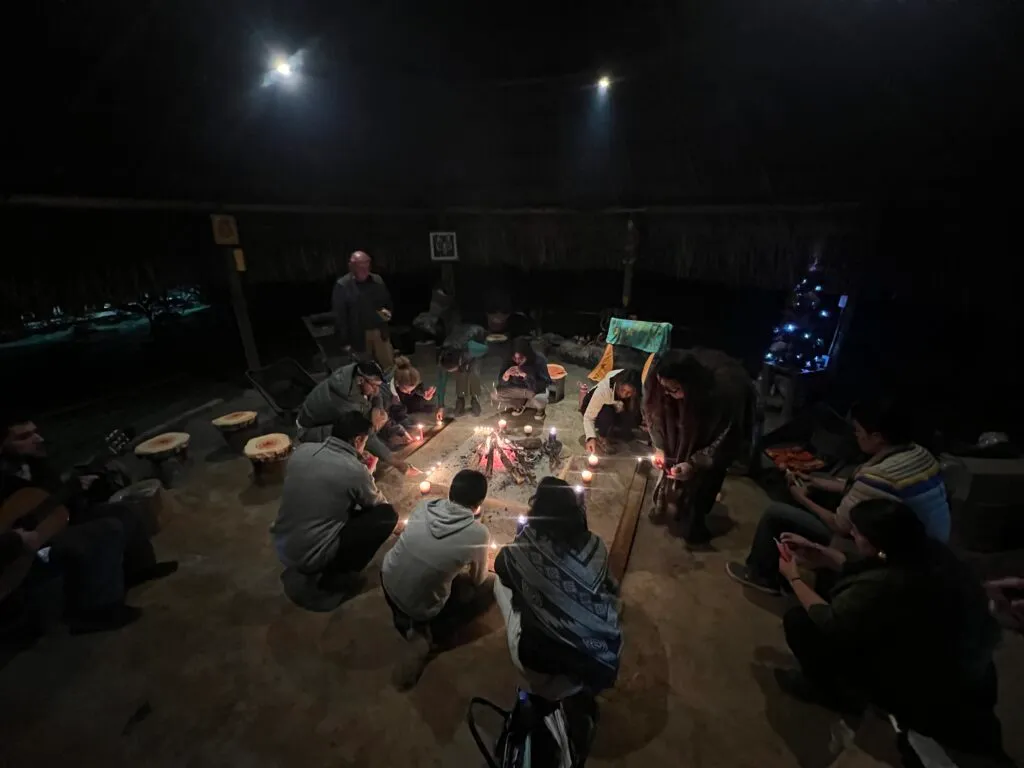
Effects often build during the first hour and may continue for several hours. In a controlled human pharmacology study, subjective effects peaked around 1.5 to 2 hours after administration, but a ceremony may last much longer than the strongest acute effects. Timing varies with the preparation, amount, individual physiology, prior food intake, and other factors.
Read the underlying study rather than treating an average as a personal prediction: Human pharmacology of ayahuasca.
Iowaska safety: screening comes first
Ayahuasca is not risk-free and is not appropriate for everyone. Certain medications, cardiovascular conditions, psychiatric histories, pregnancy, and other health factors may create serious risks. Honest medical screening should happen before choosing dates or making travel plans.
Do not stop or change prescribed medication in order to attend a ceremony without guidance from the clinician who manages your care. Retreat facilitators should explain their screening process, contraindications, emergency planning, participant-to-staff support, and what happens when someone is not eligible.
For a fuller review, read the Ayahuasca Safety Guide.
How to choose a responsible retreat
Look beyond photographs and promises. A trustworthy retreat should be clear about:
- The lineage and experience of the people guiding ceremony.
- Medical and psychological screening before acceptance.
- Preparation instructions and medication contraindications.
- The size of the group and support available throughout the night.
- Transport, accommodation, food, and practical logistics.
- Integration support during and after the retreat.
- Realistic language that does not guarantee cures or transformations.
Choosing a setting is partly about whether you feel called, but it is also a practical safety decision. Ask direct questions and notice whether the answers are specific.
Care can also mean knowing when to do less
Andrea describes her role at Camino al Sol simply: to observe, to be available and to accompany.
That does not always mean adding another activity or asking someone to talk about what they are experiencing. Part of her approach is paying attention to the person's timing and capacity.
If someone has already experienced significant physical or emotional movement, for example, another plant bath or body treatment may be left until later. Andrea describes the importance of not overloading a participant simply because another activity is available.
The same principle applies to rest. If someone needs sleep or space, that need can be respected rather than treating constant participation as the goal.
This is another practical question to consider when evaluating a retreat: does support mean keeping participants continuously occupied, or is there also room for rest, silence and individual timing?
Considering a ceremony in Colombia? See how Camino al Sol approaches lineage, medical screening, preparation, and integration before choosing a retreat.
Integration: what happens afterward matters
An intense ceremony does not automatically change daily life. Integration is the process of reflecting on what happened, resting, seeking appropriate support, and deciding which insights can be translated into grounded action.
Useful integration may include journaling, time in nature, conversations with trusted people, professional mental-health support when needed, and small changes that can be sustained. The aim is not to preserve an altered state. It is to return to relationships, work, health, and responsibility with greater honesty.
At Camino al Sol, one practice during the retreat is the Circle of Word (círculo de palabra). Andrea explains that participants are not required to describe what happened to them. Someone can speak if they want to, but they can also remain quiet and listen.
For Andrea, listening can itself be a form of participation and accompaniment. There is no requirement to explain or justify an experience before someone is ready to speak about it.
This reflects a broader principle in how she describes accompaniment: support is not always about doing more. Sometimes it means being present, listening, respecting a need for rest and giving an experience time.
For a more detailed look at this process, read our guide to ayahuasca integration.
What research can and cannot say
Scientific interest in ayahuasca has grown, but much of the research remains preliminary. Studies differ in preparation, setting, participant selection, and outcome measures. Early findings about mood, cognition, and brain activity should not be presented as proof that ayahuasca treats depression, PTSD, addiction, or other conditions.
A systematic review of human studies reported areas of potential interest while emphasizing the need for replication and stronger methods: The current state of research on ayahuasca.
Key takeaways
- Iowaska is a common phonetic spelling of ayahuasca, called yagé in Colombia.
- The brew belongs to living Indigenous and ceremonial traditions, not only a chemical definition.
- In the Putumayo context Diego Marmolejo describes, traditional medicine includes a wider body of knowledge involving medicinal plants, elders, medicinal chagras and territory.
- Effects vary and may include difficult physical and psychological experiences.
- Andrea Díaz has observed that first ceremonies can involve very different responses, including fatigue, sensitivity, silence, crying and a need to rest; these are observations, not predictions.
- Medical and psychological screening should happen before participation.
- A responsible retreat is transparent about lineage, safety, support, and integration.
- Responsible accompaniment can also include respecting a participant's need for rest, silence or space rather than continually adding activities.
- At Camino al Sol, speaking in the Circle of Word is not compulsory; participants may also listen without sharing.
- Research is promising in some areas but does not justify guaranteed medical claims.
